Healthcare Operations
ZIP
ZIP is a healthcare operations product that helps employers align care spend with actual usage while giving members, providers, and care teams a clearer way to navigate benefits, provider selection, and care coordination across separate internal and external product surfaces.
- Role
- Lead Product Designer & Frontend Developer
- Focus
- Product design, UX architecture, frontend implementation, backend-aware workflow design
Project Highlights
Product Thinking
Turned a complex care-spend model into separate product surfaces and structured flows so each audience could act without carrying the full system complexity.
Build Lens
Designed and implemented key frontend journeys while working directly with backend rules, permissions, and healthcare workflow constraints.
Outcome
Created a clearer, mobile-friendly care experience for members while making the admin platform more consistent and operationally reliable.
Problem
Employers were paying for broad healthcare coverage across every employee, even when only a small share of the workforce needed care or high-cost treatment, which made the cost model feel disconnected from real usage.
Responsibilities
- Aligned product and stakeholder input with backend rules, permissions, and healthcare workflow constraints.
- Worked across product design, UX architecture, frontend implementation, and platform hardening.
- Structured the product into separate internal and external surfaces with clear role boundaries.
- Designed and built key journeys across onboarding, care coordination, analytics, and AI-guided care flows.
- Aligned the UI with backend workflows, permissions, performance requirements, and security constraints.
Key Challenges
- Designing for multiple user groups with very different goals and constraints.
- Separating internal and external access clearly without fragmenting the product.
- Making healthcare workflows understandable for patients while preserving operational depth for admins.
- Supporting a mobile-first external experience without compromising platform complexity, safety, or auditability.
Design Decisions
- Split the platform into two distinct product surfaces instead of forcing every user through one app.
- Treated the external experience as mobile-first from the start.
- Designed the AI care journey as a structured workflow rather than a free-form chatbot.
- Standardized shared interaction patterns, states, and token-driven UI foundations across the admin platform.
- Treated performance, reliability, and compliance-aware design as core product requirements.
Outcome & Impact
The platform now gives teams a clearer separation between internal administration and member-facing care journeys, making the model easier to explain, safer to operate, and more practical to ship.
- Separated internal administration from patient-facing care so each audience saw a clearer product surface.
- Shaped the external experience around fast mobile navigation and engagement instead of admin-style interaction.
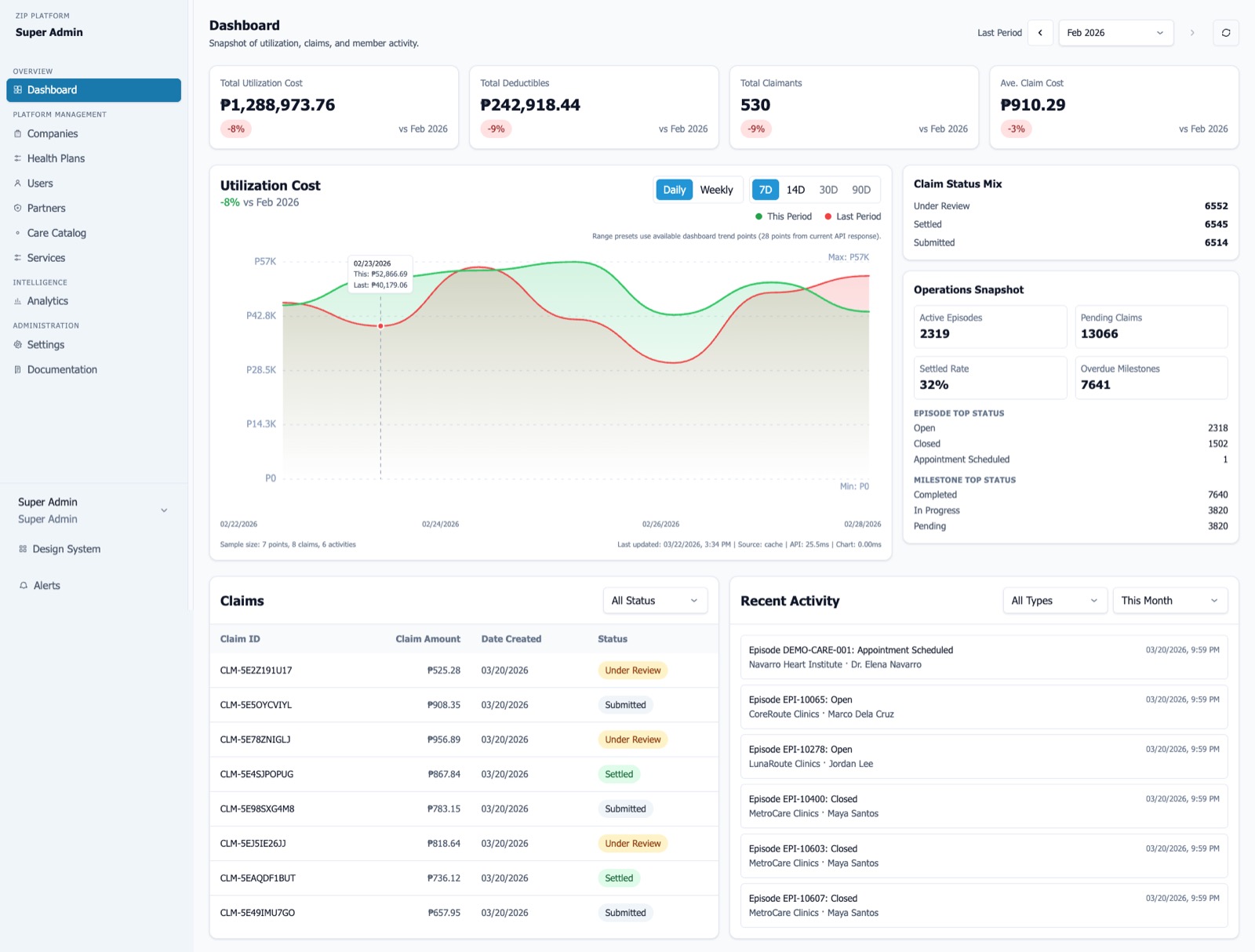
- Standardized dashboards, tables, dialogs, and management flows so the admin side felt more cohesive.
- Reduced operational surprises by tightening validation, startup behavior, caching, and runtime hardening.
- Strengthened sensitive workflows with clearer auth boundaries and safer route handling.
Tools & Technologies
Related Case Studies
Need this kind of work?
ZIP dashboard detail